Web Dubois Quote on Slaves Becoming Slaves Again

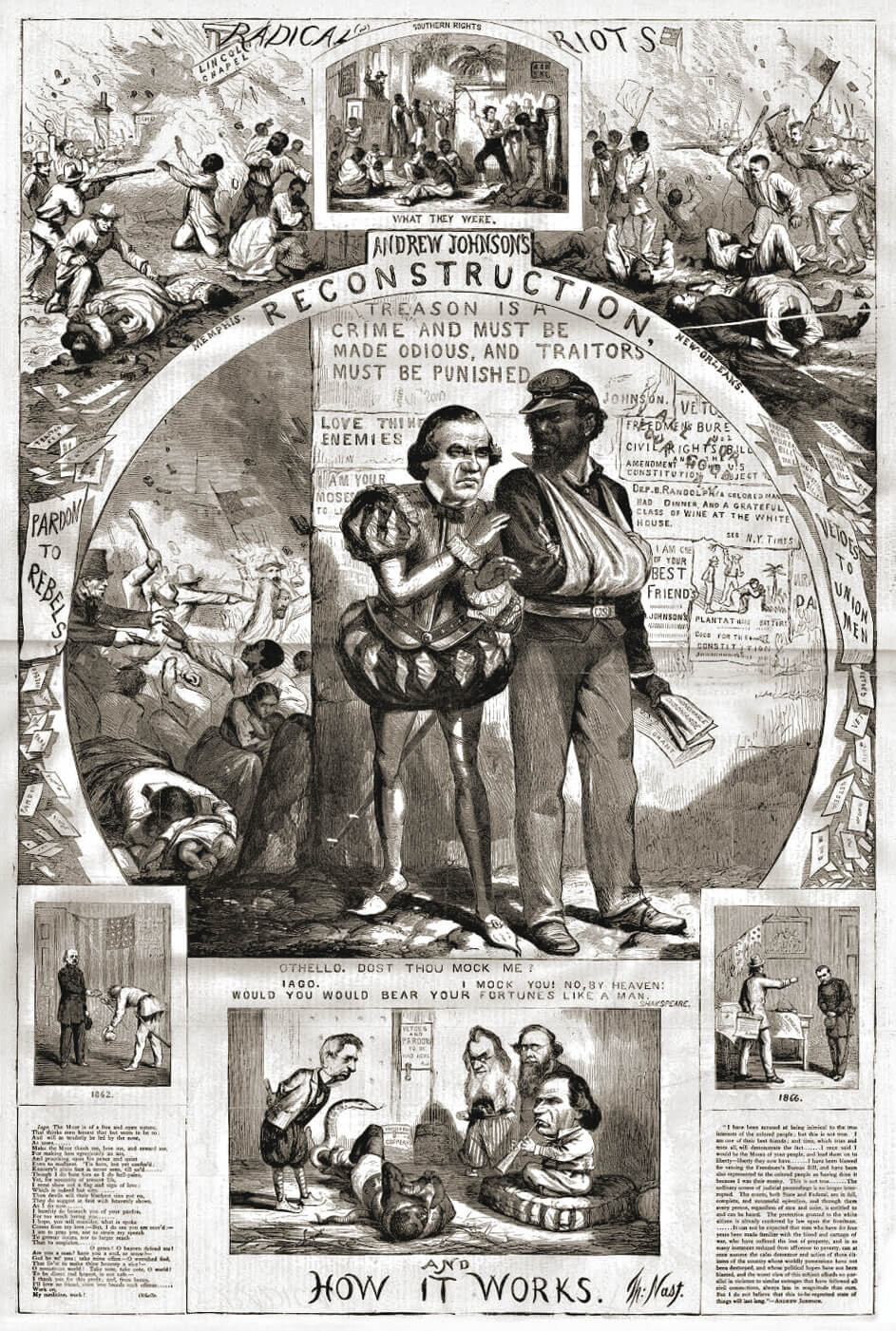
Thomas Nast's September 1866 political drawing shows President Andrew Johnson as Iago, who betrays Othello, depicted as a black veteran of the Civil State of war. (Library of Congress)
Stony the Road: Reconstruction, White Supremacy, and the Rise of Jim Crow by Henry Louis Gates, Jr.; Penguin Press, 320 pp., $30
In Black Reconstruction in America (1935), W. Due east. B. Du Bois wrote, "The slave went costless; stood for a brief moment in the sunday; then moved back once more toward slavery." The forces that pushed the freedmen back and how the black community responded are the subjects of Henry Louis Gates Jr.'southward Stony the Road, its title taken from James Weldon Johnson'due south 1900 poem "Elevator Every Voice and Sing." Gates, a distinguished scholar, filmmaker, and critic, writes with clarity and forcefulness almost Reconstruction, Redemption, and the problem of representation. He describes his book—a combination of text and visual essays—every bit "an intellectual and cultural history of black bureau in the face of white supremacy and resistance to information technology."
In the spirit of Eric Foner's Reconstruction: America'southward Unfinished Revolution (1988), Gates views Reconstruction as a revolutionary moment in American history. He emphasizes the importance of the Ceremonious Rights Act of 1866, and ratification of the Fourteenth and Fifteenth Amendments, too as efforts by African Americans to build "businesses, churches, schools and other legacy institutions." He reminds us that, during the menses, in that location were at least 2,000 elected black officeholders, including 2 United States senators and twenty representatives. With citizenship and voting rights bodacious, Frederick Douglass wrote in 1870, "at final, at final the black man has a future." How, Gates asks, was Reconstruction "immune to fail"? The answers, he suggests, "are relevant to understanding our gimmicky racial politics."
Reconstruction yielded to Redemption every bit white Southern Democrats "redeemed" their land governments from Republican control, which they derided equally "Negro rule," and crafted a multifaceted racist credo. Disquisitional to this procedure of dehumanization was "a fixed set of signs and symbols" that denigrated freed people and led to the invention of the "Quondam Negro," the portrayal of blacks equally uncivilized, illiterate, and artless, but also unsafe. Gates meticulously unravels the strands of this discourse that led 1 writer to conclude that all "scientific investigation … proves the Negro to be an ape."
White southerners asserted supremacy through the practice of lynching (justified by the myth that black men rape white women), implementing a legal system of segregation, and producing literature that perpetuated racist stereotypes. Uncle Remus, for instance, a black character popularized past Joel Chandler Harris in a book of folktales published in 1880, represents the contented plantation black human as imagined past whites. The prototype would take staying power, fabricated central to the film Song of the Southward, released in 1946, but since 1986 kept out of public view in the United States by Disney.
Gates argues confronting such cocky-suppression because racist representations are fundamental to understanding the architecture of white supremacy. The Birth of a Nation (1915) did more than than any other work to legitimize Redemption and promulgate antiblack racism. We proceed to view it, but differently now than originally intended. Gates includes two pages of images from the moving picture, evidence of how the culture manufactured a fearfulness of blackness men and justified white rule.
The book's visual essays are much more illustrations of points made in the text. They force readers to see and experience what African Americans experienced. The repeated broadcasting of what Gates calls "Sambo art" created a portrait that not only justified Jim Crow and disfranchisement just also became an archetype that "black people would see when they saw themselves reflected in America'southward social mirrors."
Gates decided to include these powerful images "without comment," writing that "they speak for themselves." Simply I wish he had presented them with the same composure he brings to his analysis of literary works. Images do not speak for themselves; like a text, they must be read. This is especially true for political cartoons, such every bit Thomas Nast'due south "Reconstruction and How It Works" (1866), which is filled with references to specific acts of violence against blacks and portrays Andrew Johnson equally Iago, who betrays Othello, depicted equally a blackness Ceremonious War veteran. Not every epitome requires extended explication, simply many deserve further historical and visual analysis.
Gates combines the literary and the pictorial in his final chapter on the New Negro. Best known equally an expression of the Harlem Renaissance, and given prominence with the publication of Alain Locke's 1925 anthology of that name, the construct dated to the tardily 19th century and marked what Gates calls "a war of representation" as blacks sought to "take back their paradigm from the choking grasp of white supremacy."
Disquisitional to this movement was photography. In 1900, at the Paris Exposition, Du Bois curated the Exhibit of American Negroes, which contained more 350 photographs of middle-class, respectable, and cultured black men and women. But as anybody in the photographs looked different, then too was there never one version of the New Negro. Du Bois'due south "talented tenth," which raised grade differences within the black community, contested with the conservatism of Booker T. Washington, the nationalism of Marcus Garvey, the activism of William Monroe Trotter, and the socialism of A. Philip Randolph.
Gates is aware that progress can pb to complacency, peradventure never more than and so than when some proclaimed the election of Barack Obama as the beginning of "a postracial America." The lessons of the past crave continued activism, he argues, and he admonishes those who think cultural expression is a form of power: "No people, in all of human history, take ever been liberated past the creation of art. None." But Gates as well knows that art can inspire. He calls jazz "the world'due south greatest art form" and quotes Langston Hughes: "jazz to me is 1 of the inherent expressions of Negro life in America: the eternal tom-tom beating in the Negro soul—the tom-tom of revolt against weariness in a white world." It may not be a political revolution, merely it sounds like liberation to me.
Source: https://theamericanscholar.org/how-the-south-rose-again/

Posting Komentar untuk "Web Dubois Quote on Slaves Becoming Slaves Again"